When gluing parts, it is best to hold them in place especially if it is a large area you need to join together, such...

Cart 0 Product Products (empty)
No products
Free shipping! Shipping
£ 0.00 Total
Product successfully added to your shopping cart
Quantity
Total
There are 0 items in your cart. There is 1 item in your cart.
Total products (tax incl.)
Total shipping (tax excl.) Free shipping!
Total (tax incl.)
Search Tips
Tips categories
Latest Tips
-
 How can I keep parts in place during gluing?Read more
 -
 What was the Bachmann 'Blue Riband' subbrand ?Read more
The Blue Riband subbrand was a significant step in the evolution of Bachmann Branchline, the UK division of Bachmann...
-
 What is a Weekend Edition model plane kit?Read more
'Weekend Edition' plastic model plane kits are a type of kit offered by plastic kit manufacturer Eduard alongside...
-
 What is a good age for a child's first layout?Read more
Several factors will influence the age at which your child is ready for their first layout. These include the...
-
 What is the best wood for baseboards?Read more
The most common wood for baseboards is probably chipboard as this is relatively inexpensive. Plywood is another...

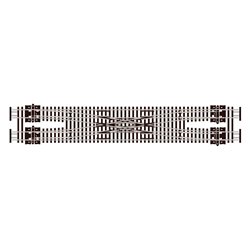
Where would I use a scissors crossing on my layout?
A scissors crossing is a type of track junction that allows trains to cross over one another without disrupting traffic flow. Typically, a scissors crossing is used in layouts where two or more tracks intersect at a single point.
A scissors crossing is formed by a diamond-shaped crossing that is positioned in such a way as to allow trains to cross over one another without interfering with other trains. The crossing is named after the appearance of the rails, which resemble a pair of scissors when viewed from above.
One common use of a scissors crossing is at the entrance to a railway station. This allows trains to enter and exit the station without interfering with other trains on the main line. Another common use is at a junction where two or more tracks converge. This allows trains to switch from one track to another without disrupting the flow of other trains on the layout. It is a compact arrangement which makes it especially useful in busy environments where space is at a premium.
The placement of a scissors crossing on a layout will depend on the specific needs and requirements of the modeller. Generally, it is placed in areas where trains need to cross over one another or switch tracks without disrupting the flow of other trains on the layout.
Overall, the scissors crossing is a useful tool for modellers who want to create complex layouts with multiple tracks and junctions. By allowing trains to cross over one another without disrupting the flow of traffic, it can enhance the realism and functionality of a model railway layout.
Posted in: Tracks
Click here to receive the tips weekly in your mailbox. You can unsubscribe at any time.
Related product
Related posts
-
 How to clean model railways track?There is of course the old tried and tested method, the track rubber which does the job, no railway modeller should...
 - Is Peco track and Hornby track compatible?Peco Setrack and Peco Streamline are compatible with Hornby track as they all share the same gauge width of 16.5mm....
- How often should I clean my track?This a hard question to answer. There are no hard and fast rules about how often you should clean the track. Bear in...
- How do I cut flexible track?Once upon a time I would have said a newly bladed junior hacksaw and some warding files, but these days I would have...
- How many pieces of curved track do I need to make a circle?As we all know it takes 360 degrees to create a circle, a standard curve is 22.5 degrees and a double curve is 45...