When new to the world of model railways, it's likely you will read many articles explaining the best way to go about...

Cart 0 Product Products (empty)
No products
Free shipping! Shipping
£ 0.00 Total
Product successfully added to your shopping cart
Quantity
Total
There are 0 items in your cart. There is 1 item in your cart.
Total products (tax incl.)
Total shipping (tax excl.) Free shipping!
Total (tax incl.)
Search Tips
Tips categories
Latest Tips
-
 What is a general purpose locomotive?Read more
 -
 In model railways, what does digital mean?Read more
The word 'digital' when used in model railways usually refers to a model or product being specifically manufactured...
-
 What is the best type of brush for spreading glue?Read more
Glue is a brush killer, so when using a brush to apply glue, you should always use a brush that you don't care too...
-
 Can I get replacement or alternative transfers for my model?Read more
There are tens of thousands of decals available covering a multitude of different models from trains, planes and...
-
 What is feedback on an analogue controller?Read more
Feedback on an analogue controller is a function that detects if your model train is experiencing difficulty climbing...

Where would I use an asymmetric 3-way turnout as opposed to a 3-way turnout?
An asymmetric 3-way turnout, also known as a Y-switch, is a type of turnout that diverges into three tracks but with one of the tracks diverging at a different angle than the other two. This creates a "Y" shape, with one branch diverging off to the side at a different angle than the other two.
The main advantage of an asymmetric 3-way turnout over a regular 3-way turnout is that it allows for greater flexibility in track design and routing. It can be used in situations where a regular 3-way turnout would not fit due to space constraints or alignment issues. For example, an asymmetric 3-way turnout could be used to create a curved track layout that merges with a straight track or to allow trains to move from one line to another at an oblique angle.
In addition, an asymmetric 3-way turnout can also be used to create a more visually interesting and dynamic track layout. It can be used to create a track plan that is more challenging to operate, with more complex routing and switching movements. This last factor is especially pleasing for modellers who relish the challenge of designing and configuring a complex layout.
Overall, the use of an asymmetric 3-way turnout is a matter of personal preference and the specific requirements of the model railway layout. It can be utilised in situations where a regular 3-way turnout would not work or to create a more visually interesting and challenging track plan.
Posted in: Tracks
Click here to receive the tips weekly in your mailbox. You can unsubscribe at any time.
Related products
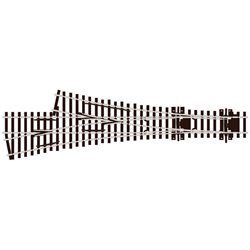
Asymmetric Three Way Turnout HO/OO Code 75
Price: £ 62.75Asymmetric Three Way Turnout HO/OO Code 75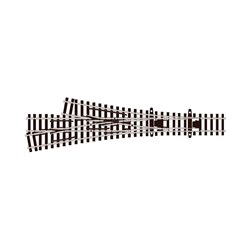
C55 Asymetric 3-Way Turnout, Medium Radius
Price: £ 60.50C55 Asymetric 3-Way Turnout, Medium Radius
Related posts
-
 How to clean model railways track?There is of course the old tried and tested method, the track rubber which does the job, no railway modeller should...
 - Is Peco track and Hornby track compatible?Peco Setrack and Peco Streamline are compatible with Hornby track as they all share the same gauge width of 16.5mm....
- How often should I clean my track?This a hard question to answer. There are no hard and fast rules about how often you should clean the track. Bear in...
- How do I cut flexible track?Once upon a time I would have said a newly bladed junior hacksaw and some warding files, but these days I would have...
- How many pieces of curved track do I need to make a circle?As we all know it takes 360 degrees to create a circle, a standard curve is 22.5 degrees and a double curve is 45...