A toggle switch is one of the most basic switches used on model railways, but it's also one of the most useful!A...

Cart 0 Product Products (empty)
No products
Free shipping! Shipping
£ 0.00 Total
Product successfully added to your shopping cart
Quantity
Total
There are 0 items in your cart. There is 1 item in your cart.
Total products (tax incl.)
Total shipping (tax excl.) Free shipping!
Total (tax incl.)
Search Tips
Tips categories
Latest Tips
-
 What is a toggle button switch?Read more
 -
 What is a mitre box?Read more
A mitre box is a metal framework designed to hold an item of building material in place while you saw through it at...
-
 Are starter sets a good basis to develop a layout from?Read more
Starter sets can be a great way for novice modellers to begin their journey into model railway or scale modelling....
-
 Avoiding the "Toy Train Look": Realistic Track ArrangementsRead more
A well-designed model railway is more than just a collection of tracks and trains: it’s a miniature world that...
-
 What is a micro-layout?Read more
A micro layout refers to a very small and compact model railways layout that is designed to fit within a confined...

What are my options for motorising a level crossing?
There are a few options for motorising a level crossing on a model railway layout:
Servo motor: One option is to use a servo motor to operate the level crossing gates. Servo motors can be controlled with a servo decoder, allowing smooth operation of the gates remotely through the layout's control system. They can be a good option for layouts with more complex control requirements.
Solenoid motor: Another option is to use a solenoid motor to operate the level crossing gates. Solenoids can be controlled through a switch or a relay, and provide a strong and reliable mechanism for opening and closing the gates.
DC motor: A DC motor can also be used to operate the level crossing gates. They can be operated with a motor controller and can provide smooth and reliable operation for the gates.
Integrated motor: Some level crossing models come with an integrated motor or motorised mechanism. These can be a good option if the modeller requires a simple and easy-to-install solution for their layout.
When choosing a motorising option for a level crossing, it is important to consider a number of factors such as the size and weight of the gates, the layout's control system, and the budget. With the right motorising system, it is easily possible to add a realistic and functional level crossing to a model railway layout.
Posted in: Power and control
Click here to receive the tips weekly in your mailbox. You can unsubscribe at any time.
Related products
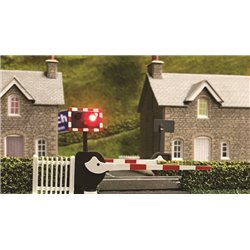
Level Crossing Barrier Set with Light & Sound...
Price: £ 30.50Level Crossing Barrier Set with Light & Sound (OO) Contents list:• Level...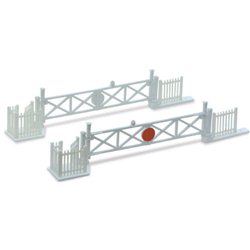
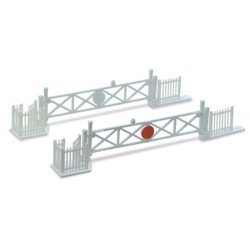
N level crossing gates
Price: £ 7.70Level crossing gates Traditional wooden type gates complete with the usual...
Related posts
-
 Can a "DCC ready" train be used on analogue?Yes, you can use a DCC ready train on your analogue layout. DCC ready just means that the train has been factory...
 - Is it difficult to fit a DCC decoder in to a DCC ready engine?In theory, it should be easy as the whole idea of being DCC Ready is to simplify the process. The first time I did...
- What is 7/0.2 wire?7/02 wire is a wire made of 7 strands of 0.2mm wire. Stranded wire has the advantage of being flexible while solid...
- Is an N Gauge controller compatible with OO Gauge?Yes, an N Gauge controller is compatible with OO gauge trains. You may have to change the power clip to the track...
- Is stranded wire better than solid wire?In my experience, stranded wire is preferable over solid wire. Stranded wire is more flexible than solid core wire,...