When gluing parts, it is best to hold them in place especially if it is a large area you need to join together, such...

Cart 0 Product Products (empty)
No products
Free shipping! Shipping
£ 0.00 Total
Product successfully added to your shopping cart
Quantity
Total
There are 0 items in your cart. There is 1 item in your cart.
Total products (tax incl.)
Total shipping (tax excl.) Free shipping!
Total (tax incl.)
Search Tips
Tips categories
Latest Tips
-
 How can I keep parts in place during gluing?Read more
 -
 What was the Bachmann 'Blue Riband' subbrand ?Read more
The Blue Riband subbrand was a significant step in the evolution of Bachmann Branchline, the UK division of Bachmann...
-
 What is a Weekend Edition model plane kit?Read more
'Weekend Edition' plastic model plane kits are a type of kit offered by plastic kit manufacturer Eduard alongside...
-
 What is a good age for a child's first layout?Read more
Several factors will influence the age at which your child is ready for their first layout. These include the...
-
 What is the best wood for baseboards?Read more
The most common wood for baseboards is probably chipboard as this is relatively inexpensive. Plywood is another...

What are the pros and cons of using flexible track in my layout?
One of the biggest advantages of using flexible track in a model railway layout is its ability to form curved and irregularly shaped track sections that would be difficult or impossible to create by other means. It is also relatively easy to install and adjust. Flexible track can also be cut to size, allowing for custom fitting in tight spaces.
The cons of using flexible track include its tendency to sag over time. This can lead to derailments, especially over longer track sections. It is also less durable than rigid track and may require more frequent replacement. As flexible track is generally used by modellers to create specific curves it will inevitably create compatibility issues for a modeller intending to use foam ballast, as the latter may not be able to match the shape of the track. Additionally, some hobbyists consider the appearance of flexible track to be less realistic than that of rigid track segments.
Flexible track certainly has its pros and cons but it is a useful alternative for a modeller to have in their toolkit when designing a layout. Like so many aspects of layout design, its use is a matter of personal choice by the modeller. Admittedly, it won't be the answer in all cases but there will inevitably be occasions where its use would be highly advantageous.
Posted in: Tracks
Click here to receive the tips weekly in your mailbox. You can unsubscribe at any time.
Related products
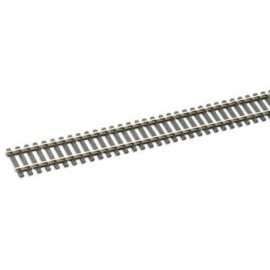
Peco Streamline OO gauge Flexible Track - Code 100
Price: £ 6.40OO gauge Peco Streamline Code 100 Flexible Track with wooden effect...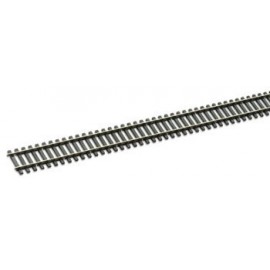
Flexible Track, Wooden Sleeper Finescale code...
Price: £ 6.80Flexible Track, Wooden Sleeper Finescale code 75 1 yard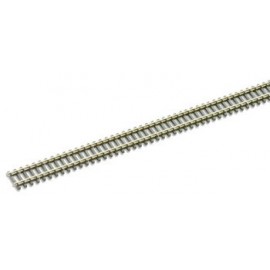
N Flexible Track with Wooden Sleeper (nickel...
Price: £ 5.80N Flexible Track with Wooden Sleeper (nickel silver rail)
Related posts
-
 How to clean model railways track?There is of course the old tried and tested method, the track rubber which does the job, no railway modeller should...
 - Is Peco track and Hornby track compatible?Peco Setrack and Peco Streamline are compatible with Hornby track as they all share the same gauge width of 16.5mm....
- How often should I clean my track?This a hard question to answer. There are no hard and fast rules about how often you should clean the track. Bear in...
- How do I cut flexible track?Once upon a time I would have said a newly bladed junior hacksaw and some warding files, but these days I would have...
- How many pieces of curved track do I need to make a circle?As we all know it takes 360 degrees to create a circle, a standard curve is 22.5 degrees and a double curve is 45...