That would very much depend on what it is you are trying to glue the balsa wood to, if you are gluing it to another...

Cart 0 Product Products (empty)
No products
Free shipping! Shipping
£ 0.00 Total
Product successfully added to your shopping cart
Quantity
Total
There are 0 items in your cart. There is 1 item in your cart.
Total products (tax incl.)
Total shipping (tax excl.) Free shipping!
Total (tax incl.)
Search Tips
Tips categories
Latest Tips
-
 How do I glue balsa wood?Read more
 -
 What is an A1A-A1A wheel arrangement?Read more
In the UK, an A1A-A1A wheel arrangement was used on some early designs of diesel railway locomotives, most notably...
-
 How to fit drivers in locomotivesRead more
Installing a driver or fireman into your locomotive can really bring it to life and add realism. After all, in real...
-
 Do cambers help model trains traverse a bend?Read more
In real life, railway tracks tilt slightly as they negotiate curves. The tilt is known by many names, including a...
-
 Is modelling in N gauge cheaper than OO gauge?Read more
Although N gauge is very popular (and for good reason), it can't be denied that the most popular gauge on the UK...

What are the best tools to cut wooden parts such as planks for a period ship ?
Wooden parts supplied with some kits can be quite thick and can offer significant resistance when a standard hobby knife is used to cut them. Additionally, modellers may have to contend with the inherent grain of the wood which can also make cutting complicated.
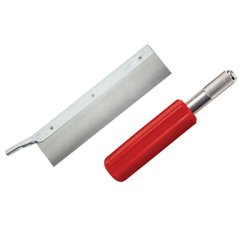
Perhaps the best tool to use for cutting precision wooden parts is a razor saw. Many hobby shops will supply these as standard. They are durable precision tools that can be purchased reasonably cheaply and inevitably will be versatile enough to be used in a wide variety of modelling projects. Many hobby knives will be supplied with a selection of blades. These are likely to offer a choice of teeth count per inch. Blades with a low tooth count are good for general-purpose use, those with a high count offer greater precision and a tidy, clean cut.
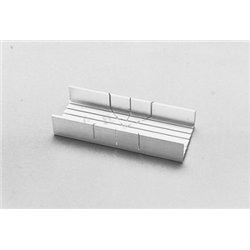
When using a razor saw it is helpful to get the alignment just right. One thing that can help with this is a mitre box. These are aluminium boxes that have pre-cut grooves at specific angles. These grooves are specifically designed for razor saws and will ensure a clean and tidy cut.
Regular use can easily dull the teeth on the blades of a razor saw. To help with blade longevity it is important to clean the blade after use to remove any debris that can accumulate. Regular cleaning of the blade with bees wax will also help protect the blade teeth ensuring a smoother and more efficient cut.
Posted in: Best practices
Click here to receive the tips weekly in your mailbox. You can unsubscribe at any time.
Related products
Razor saw set handle + 1 blade
Price: £ 13.20Razor saw set handle + 1 blade Includes heavy duty K5 hobby knife handle, a...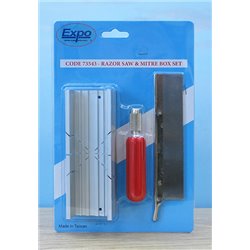
Related posts
-
 Do I need a respirator?If you are using an aerosol spray paint you should always use one. Always read the manufacturer’s...
 - How to remove super glue (cyanoacrylate)?Cyanoacrylate is best known as super glue. The best way to remove it is with acetone or an acetone-based product...
- What is the best wood for baseboards?The most common wood for baseboards is probably chipboard as this is relatively inexpensive. Plywood is another...
- How do I stick parts together for a test fit?There are several trains of thought on the best way to secure parts together temporarily. Some suggest using a small...
- How to clean model railways track?There is of course the old tried and tested method, the track rubber which does the job, no railway modeller should...