Bogie Sulphate Wagons were, at the time, famed for being the largest open wagons of their type, but their demise was...

Cart 0 Product Products (empty)
No products
Free shipping! Shipping
£ 0.00 Total
Product successfully added to your shopping cart
Quantity
Total
There are 0 items in your cart. There is 1 item in your cart.
Total products (tax incl.)
Total shipping (tax excl.) Free shipping!
Total (tax incl.)
Search Tips
Tips categories
Latest Tips
-
 What is a bogie sulphate wagon?Read more
 -
 What is the best way to glue a cardboard building kit?Read more
The best way to glue a cardboard kit like Metcalfe or Superquick is to read and follow the instructions that are...
-
 How do I get started with weathering a plane?Read more
Weathering a plane is a fantastic way to add realism and character to your aircraft. It involves replicating the...
-
 What is the HOm scale?Read more
The HOm scale is a popular narrow-gauge modelling scale used by enthusiasts to represent railways that are smaller...
-
 What kind of solder should I use on white metal kits?Read more
If you are soldering a white-metal kit together, you will need to use a lower temperature setting on your soldering...

What tools can I use to keep my track clean?
Dirty track can result in locomotives failing to run properly on a layout. If dirt or grime is present on the track then this can be transferred onto the wheels of a locomotive which will then potentially impair the electrical contact between the track and the motor of the locomotive.
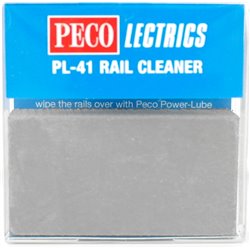
One of the most common means of removing deposits of dirt and grime is a track rubber. These have a slightly abrasive surface which is effective at cleaning the track and removing unwanted grime. Track rubbers are hard-wearing and small which means they can be effectively used on all areas of the track including those difficult-to-reach sections. Although abrasive the track rubber is a forgiving medium that can be used frequently without any adverse effects on the track. It is useful to use this in combination with a small, handheld vacuum cleaner to suck up any resultant debris.
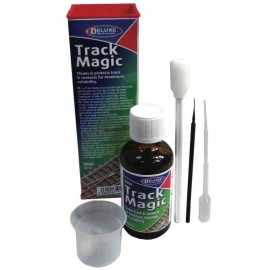
Track Magic is a liquid-based cleaner specifically formulated to clean tracks and can be used either as an alternative to or in combination with a track rubber. The fluid is applied by a pad to the track which helps not only to clean the surface but also provides a more conductive surface which enables locomotives to run more smoothly. Track magic can also be easily applied to more delicate sections of track such as points where the over zealous use of a track rubber may cause damage.
Some modellers also use track cleaning rolling stock. These items are specifically configured with small track shoes with an abrasive surface which can prove very effective at keeping track surfaces clean. All of the above methods are effective cleaning mechanisms and although they can each be used as a stand-alone medium, when used in combination they offer a very effective cleaning solution for all areas of the track.
Posted in: Tracks
Click here to receive the tips weekly in your mailbox. You can unsubscribe at any time.
Related products
Related posts
-
 How to clean model railways track?There is of course the old tried and tested method, the track rubber which does the job, no railway modeller should...
 - Is Peco track and Hornby track compatible?Peco Setrack and Peco Streamline are compatible with Hornby track as they all share the same gauge width of 16.5mm....
- How often should I clean my track?This a hard question to answer. There are no hard and fast rules about how often you should clean the track. Bear in...
- How do I cut flexible track?Once upon a time I would have said a newly bladed junior hacksaw and some warding files, but these days I would have...
- How many pieces of curved track do I need to make a circle?As we all know it takes 360 degrees to create a circle, a standard curve is 22.5 degrees and a double curve is 45...