Bogie Sulphate Wagons were, at the time, famed for being the largest open wagons of their type, but their demise was...

Cart 0 Product Products (empty)
No products
Free shipping! Shipping
£ 0.00 Total
Product successfully added to your shopping cart
Quantity
Total
There are 0 items in your cart. There is 1 item in your cart.
Total products (tax incl.)
Total shipping (tax excl.) Free shipping!
Total (tax incl.)
Search Tips
Tips categories
Latest Tips
-
 What is a bogie sulphate wagon?Read more
 -
 What is the best way to glue a cardboard building kit?Read more
The best way to glue a cardboard kit like Metcalfe or Superquick is to read and follow the instructions that are...
-
 How do I get started with weathering a plane?Read more
Weathering a plane is a fantastic way to add realism and character to your aircraft. It involves replicating the...
-
 What is the HOm scale?Read more
The HOm scale is a popular narrow-gauge modelling scale used by enthusiasts to represent railways that are smaller...
-
 What kind of solder should I use on white metal kits?Read more
If you are soldering a white-metal kit together, you will need to use a lower temperature setting on your soldering...

What is model railway ballast inlay?
Ballast inlays are sponge strips designed for placement under model railway track to cushion it whilst replicating ballast.
Inlay for straight and curved track sections is typically supplied on a roll but specific sections are required for points and crossovers etc.
A nice feature of ballast inlay is the track profile moulded into it that ensures the ballast effect reaches the tops of the sleepers. Another advantage of using ballast inlay is the cushioning effect that results in the quieter running of trains.
There are, however, a few negative aspects of using a ballast inlay. The first is its requirement to be replaced after around five or six years due to it perishing. Another potential downside is that its popularity amongst modellers is dwindling and production appears to be decreasing by comparison. The reason for the lack of enthusiasm is likely because real ballast simply looks better, although it should be pointed out that real ballast can be applied on top of the inlay to produced a prototypical raised track bed.
Posted in: Tracks
Click here to receive the tips weekly in your mailbox. You can unsubscribe at any time.
Related products
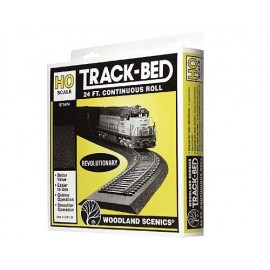
HO Scale Trackbed Roll 24ft.
Price: £ 16.50Totally flat areas of land are very rare in nature. They usually occur as...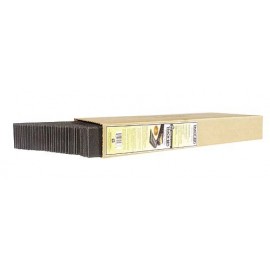
HO Scale Trackbed Strips Bulk 36/Pkg
Price: £ 39.75Totally flat areas of land are very rare in nature. They usually occur as...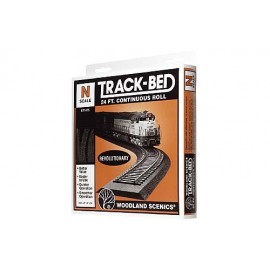
N Scale Trackbed Roll 24ft.
Price: £ 13.25Totally flat areas of land are very rare in nature. They usually occur as...
Related posts
-
 How to clean model railways track?There is of course the old tried and tested method, the track rubber which does the job, no railway modeller should...
 - Is Peco track and Hornby track compatible?Peco Setrack and Peco Streamline are compatible with Hornby track as they all share the same gauge width of 16.5mm....
- How often should I clean my track?This a hard question to answer. There are no hard and fast rules about how often you should clean the track. Bear in...
- How do I cut flexible track?Once upon a time I would have said a newly bladed junior hacksaw and some warding files, but these days I would have...
- How many pieces of curved track do I need to make a circle?As we all know it takes 360 degrees to create a circle, a standard curve is 22.5 degrees and a double curve is 45...