If you are new to modelling or considering your first layout, you may be wondering if it is possible to run...

Cart 0 Product Products (empty)
No products
Free shipping! Shipping
£ 0.00 Total
Product successfully added to your shopping cart
Quantity
Total
There are 0 items in your cart. There is 1 item in your cart.
Total products (tax incl.)
Total shipping (tax excl.) Free shipping!
Total (tax incl.)
Search Tips
Tips categories
Latest Tips
-
 How can I run two engines in opposite directions?Read more
 -
 What does AFV mean in military scale modelling?Read more
AFV stands for Armoured Fighting Vehicle. These versatile military machines come in many shapes, sizes and forms but...
-
 How do I bend plastic?Read more
BEWARE RISK OF BURNS With most plastic, hot water is usually enough to bend it. If you are straightening weapon...
-
 What is the Scalefour Society?Read more
The Scalefour Society is a British organisation dedicated to the promotion and modelling of railways using the 4mm to...
-
 What is a Plux22 DCC decoder?Read more
A Plux22 DCC decoder is a type of digital decoder used in model railways to control locomotives fitted with a Plux22...

What is the smallest scale?
The smallest commercial scale in railway modelling is T Gauge.
It runs on 3mm track and is 1/450 in scale. It is approximately a third of the size of N gauge.
Because of the small weight, wheels are magnetic to improve traction.
Two British outline locomotives are available: HST 125 and Class 67. Generic rolling stock (container wagons and tanker wagons) can help create a small train formation.
Availability is limited but due to the size and the difficult to build realistic items that small, most people consider the scale a proof of concept rather than a working modelling scale.
Posted in: Model Railway
Click here to receive the tips weekly in your mailbox. You can unsubscribe at any time.
Related products
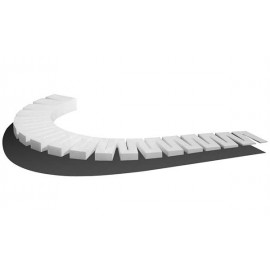
2% Incline/Decline Starters - pack of 8
Price: £ 15.00Totally flat areas of land are very rare in nature. They usually occur as...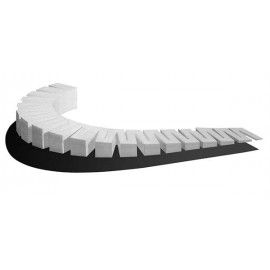
4% Incline/Decline Starters - pack of 4
Price: £ 15.00Totally flat areas of land are very rare in nature. They usually occur as...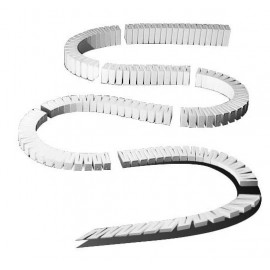
2% Foam Incline/Decline set - Pack of 8...
Price: £ 30.75Totally flat areas of land are very rare in nature. They usually occur as...
Related posts
-
 What scale is Hornby?Hornby model railways are OO Scale or 1/76th that is 4 millimetres to the foot (12 inches). It runs on a track with...
 - How to weight my model so it does not tip?For wargaming figures, a small coin or washer glued to the under side of the base will usually to do the job. This...
- Is Bachmann compatible with Hornby?Yes, any OO scale loco, wagon or coach will work on any OO scale track, regardless of brand. Couplings are also...
- What are the model railway eras?According to Bachmann, as it states in their catalogue there are 9 eras. As they say in their catalogue this is not...
- Can a "DCC ready" train be used on analogue?Yes, you can use a DCC ready train on your analogue layout. DCC ready just means that the train has been factory...