That would very much depend on what it is you are trying to glue the balsa wood to, if you are gluing it to another...

Cart 0 Product Products (empty)
No products
Free shipping! Shipping
£ 0.00 Total
Product successfully added to your shopping cart
Quantity
Total
There are 0 items in your cart. There is 1 item in your cart.
Total products (tax incl.)
Total shipping (tax excl.) Free shipping!
Total (tax incl.)
Search Tips
Tips categories
Latest Tips
-
 How do I glue balsa wood?Read more
 -
 What is an A1A-A1A wheel arrangement?Read more
In the UK, an A1A-A1A wheel arrangement was used on some early designs of diesel railway locomotives, most notably...
-
 How to fit drivers in locomotivesRead more
Installing a driver or fireman into your locomotive can really bring it to life and add realism. After all, in real...
-
 Do cambers help model trains traverse a bend?Read more
In real life, railway tracks tilt slightly as they negotiate curves. The tilt is known by many names, including a...
-
 Is modelling in N gauge cheaper than OO gauge?Read more
Although N gauge is very popular (and for good reason), it can't be denied that the most popular gauge on the UK...

Do I need to apply a camber to a tight curve of track on my layout?
Applying a camber to a tight curve of track on your model railway layout can help improve the realism and operation of the layout. A camber is a slight banking or tilt of the track on a curve, which helps to counteract the centrifugal force that pushes trains outward as they go around the curve.
In real life, camber is applied to curves on mainline railways to allow trains to travel at higher speeds with greater stability and safety. Applying a similar camber to your model railway layout can help prevent derailments and improve the overall appearance and operation of the layout.
However, whether or not you need to apply a camber to a tight curve on your layout will depend on a variety of factors, such as the scale of the layout, the size of the curves and the types of trains you are running. In general, larger scales and tighter curves will benefit more from a camber than smaller scales or gentler curves.
Ultimately, the decision to apply a camber to a tight curve on your layout is up to you, based on your personal preferences and goals for the layout. If you want to create a highly realistic and prototypical layout, then applying a camber to tight curves can be an effective way to achieve that goal. If you are more focused on fun and entertainment, then a camber may not be necessary and you can enjoy running your trains around the curves as they are.
Posted in: Tracks
Click here to receive the tips weekly in your mailbox. You can unsubscribe at any time.
Related products
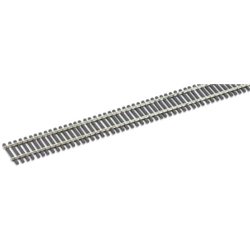
Nickel Silver Code 83 Wooden Sleepered Flexible
Price: £ 6.60Nickel Silver Code 83 Wooden Sleepered Flexible 914mm Wooden type, nickle...
Nickel Silver Code 55 Wooden Sleepered (nickel...
Price: £ 6.70Nickel Silver Code 55 Wooden Sleepered (nickel silver rail) Flexible...
Flexible Track, Wooden Sleeper Finescale code...
Price: £ 6.80Flexible Track, Wooden Sleeper Finescale code 75 1 yard
Related posts
-
 How to clean model railways track?There is of course the old tried and tested method, the track rubber which does the job, no railway modeller should...
 - Is Peco track and Hornby track compatible?Peco Setrack and Peco Streamline are compatible with Hornby track as they all share the same gauge width of 16.5mm....
- How often should I clean my track?This a hard question to answer. There are no hard and fast rules about how often you should clean the track. Bear in...
- How do I cut flexible track?Once upon a time I would have said a newly bladed junior hacksaw and some warding files, but these days I would have...
- How many pieces of curved track do I need to make a circle?As we all know it takes 360 degrees to create a circle, a standard curve is 22.5 degrees and a double curve is 45...