When gluing parts, it is best to hold them in place especially if it is a large area you need to join together, such...

Cart 0 Product Products (empty)
No products
Free shipping! Shipping
£ 0.00 Total
Product successfully added to your shopping cart
Quantity
Total
There are 0 items in your cart. There is 1 item in your cart.
Total products (tax incl.)
Total shipping (tax excl.) Free shipping!
Total (tax incl.)
Search Tips
Tips categories
Latest Tips
-
 How can I keep parts in place during gluing?Read more
 -
 What was the Bachmann 'Blue Riband' subbrand ?Read more
The Blue Riband subbrand was a significant step in the evolution of Bachmann Branchline, the UK division of Bachmann...
-
 What is a Weekend Edition model plane kit?Read more
'Weekend Edition' plastic model plane kits are a type of kit offered by plastic kit manufacturer Eduard alongside...
-
 What is a good age for a child's first layout?Read more
Several factors will influence the age at which your child is ready for their first layout. These include the...
-
 What is the best wood for baseboards?Read more
The most common wood for baseboards is probably chipboard as this is relatively inexpensive. Plywood is another...

How can I add realistic tyre tracks to muddy terrain?
Adding realistic tyre tracks to muddy terrain in your scale model can enhance the scene’s authenticity and tell a story of recent activity. Here's how you can achieve convincing results:
1. Choose the Right Mud Texture
Start by selecting a suitable material for your muddy surface. Options include:
- Acrylic Paste – Mix acrylic modelling paste with brown and grey paint for a wet mud effect.
- Plaster or Polyfilla – When mixed with paint and applied thickly, this works well for dried or churned-up mud.
- Real Soil or Fine Sand – Sieved and mixed with PVA glue, it gives a natural, textured surface.
2. Create Tyre Impressions While the Mud is Soft
To make tyre tracks, press a scale-accurate spare wheel or tyre into the soft material before it fully sets. Roll it gently to create a continuous track. Ensure the tread pattern matches the type of vehicle in your scene.
3. Use Stencils for Precise Tracks
If the mud has already dried, you can use a stencil or stamp to press tread patterns into the surface. Some modellers create their own by rolling a tyre in putty, then using it as a stamp once hardened.
4. Layering for Depth
Realistic tracks aren't just indentations, they have raised edges where mud has been pushed aside. Build up the sides of the tracks using extra paste, fine sand or sculpted putty.
5. Add Wet or Dry Mud Effects
- For wet mud, apply a gloss varnish or a mix of PVA glue and water to selected areas.
- For dried mud, drybrush lighter brown tones over raised areas to highlight texture.
6. Blend with the Surrounding Terrain
Feather out the edges of the tracks into the surrounding mud using a soft brush or sponge. This prevents them from looking too artificial or harsh.
7. Add Small Details for Realism
- Scatter small puddles in deep ruts by adding clear resin or gloss varnish.
- Use mud splatters near the tracks by flicking thinned paint with an old toothbrush.
- Embed tiny stones or debris in the tracks for added realism.
Posted in: Scenery
Click here to receive the tips weekly in your mailbox. You can unsubscribe at any time.
Related products
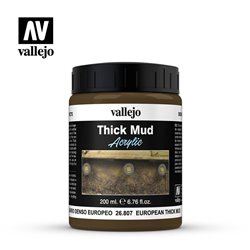
Vallejo Weathering Effects 200ml - European...
Price: £ 13.50Vallejo Weathering Effects - European Thick Mud 200 ml./6.76 fl.oz. pot.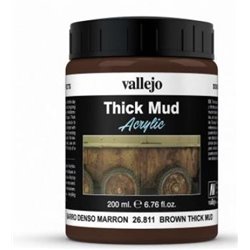
Vallejo Weathering Effects 200ml - Brown Thick Mud
Price: £ 13.50Vallejo Weathering Effects 200ml - Brown Thick Mud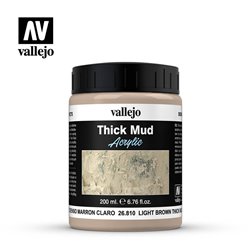
Weathering Effects 200ml - Light Brown Thick Mud
Price: £ 13.50Weathering Effects 200ml - Light Brown Thick Mud Light Brown Thick Mud, the...
Related posts
-
 Is static grass better than scatter?I use both, separately and together. Static grass comes in various sizes from 0.5mm to 12mm while scatter is...
 - How do I apply static grass?Static grass is best applied using a static grass applicator. There are several on the market and they can apply...
- What colour are tree trunks?Tree trunks are actually grey in colour and not brown as you would think. The next time you are out and about just...
- How to make hills?You can make hills in a variety of ways. The tried and tested way is with chicken wire and papier mache. This is a...
- How do I glue scatter?Select the area where you want the scatter, then apply a layer of PVA glue, sprinkle your grass covering the glue....