Bogie Sulphate Wagons were, at the time, famed for being the largest open wagons of their type, but their demise was...

Cart 0 Product Products (empty)
No products
Free shipping! Shipping
£ 0.00 Total
Product successfully added to your shopping cart
Quantity
Total
There are 0 items in your cart. There is 1 item in your cart.
Total products (tax incl.)
Total shipping (tax excl.) Free shipping!
Total (tax incl.)
Search Tips
Tips categories
Latest Tips
-
 What is a bogie sulphate wagon?Read more
 -
 What is the best way to glue a cardboard building kit?Read more
The best way to glue a cardboard kit like Metcalfe or Superquick is to read and follow the instructions that are...
-
 How do I get started with weathering a plane?Read more
Weathering a plane is a fantastic way to add realism and character to your aircraft. It involves replicating the...
-
 What is the HOm scale?Read more
The HOm scale is a popular narrow-gauge modelling scale used by enthusiasts to represent railways that are smaller...
-
 What kind of solder should I use on white metal kits?Read more
If you are soldering a white-metal kit together, you will need to use a lower temperature setting on your soldering...

When and where are sleeper built buffer stops used?
Sleeper-built buffer stops, commonly used in railway systems, serve as an essential safety mechanism at the end of tracks. They are particularly important in preventing trains from overrunning the end of the track and potentially causing accidents or damage. Here’s a detailed overview of their use:
When Sleeper-Built Buffer Stops are Used
- End of Sidings: Sleeper-built buffer stops are frequently found at the end of sidings or spur tracks. Sidings are low-speed tracks used for loading, unloading, or storing railway wagons.
- Terminus Stations: At terminus stations where tracks end, buffer stops are crucial in halting trains safely as they reach the end of the line.
- Maintenance Yards: In maintenance and storage yards where trains are parked, sleeper-built buffer stops ensure that rolling stock does not go beyond the designated area.
- Emergency Scenarios: They can also be used in emergency scenarios where temporary track endings require a quick and reliable stop mechanism.
- Temporary Tracks: On construction sites or temporary tracks, sleeper-built buffer stops can be a quick and effective way to ensure safety at track ends.
Where Sleeper-Built Buffer Stops are Used
- Industrial Areas: Often found in industrial railway systems where tracks frequently end at loading docks or warehouses.
- Urban Rail Networks: In metropolitan areas, especially in underground or elevated rail systems where tracks terminate at stations.
- Rural Rail Lines: On rural or less frequented rail lines where tracks may end abruptly or temporarily due to construction or maintenance work.
- Heritage Railways: Used in heritage or preserved railways where traditional construction methods are preferred.
- Low-Speed Rail Lines: They are more common on low-speed rail lines due to the nature of their construction and the type of rolling stock they serve.
Characteristics of Sleeper-Built Buffer Stops
- Construction: Typically constructed using old railway sleepers (ties), arranged horizontally or vertically, and reinforced with metal brackets or other supports.
- Durability: Built to absorb the impact of a slow-moving train, they are sturdy and durable, though not designed for high-speed impacts.
- Maintenance: Require regular inspection and maintenance to ensure they remain effective and safe.
- Cost-Effective: Often a cost-effective solution, utilising readily available materials from the railway environment.
In summary, sleeper-built buffer stops are an important safety feature in various railway environments, particularly in locations where trains operate at lower speeds and where tracks frequently terminate. Their construction and usage are tailored to the specific needs of the rail system, ensuring that trains can be stopped safely and effectively at the end of the track.
Posted in: Model Railway
Click here to receive the tips weekly in your mailbox. You can unsubscribe at any time.
Related products
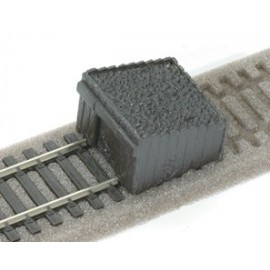
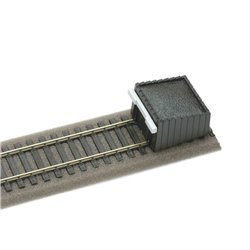
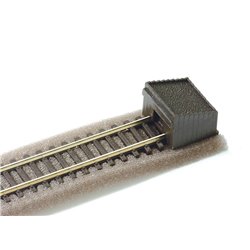
Buffer Stop, Sleeper Built Type - pack of 2
Price: £ 3.25Buffer Stop, Sleeper Built Type - pack of 2
Related posts
-
 What scale is Hornby?Hornby model railways are OO Scale or 1/76th that is 4 millimetres to the foot (12 inches). It runs on a track with...
 - How to weight my model so it does not tip?For wargaming figures, a small coin or washer glued to the under side of the base will usually to do the job. This...
- Is Bachmann compatible with Hornby?Yes, any OO scale loco, wagon or coach will work on any OO scale track, regardless of brand. Couplings are also...
- What are the model railway eras?According to Bachmann, as it states in their catalogue there are 9 eras. As they say in their catalogue this is not...
- Can a "DCC ready" train be used on analogue?Yes, you can use a DCC ready train on your analogue layout. DCC ready just means that the train has been factory...