That would very much depend on what it is you are trying to glue the balsa wood to, if you are gluing it to another...

Cart 0 Product Products (empty)
No products
Free shipping! Shipping
£ 0.00 Total
Product successfully added to your shopping cart
Quantity
Total
There are 0 items in your cart. There is 1 item in your cart.
Total products (tax incl.)
Total shipping (tax excl.) Free shipping!
Total (tax incl.)
Search Tips
Tips categories
Latest Tips
-
 How do I glue balsa wood?Read more
 -
 What is an A1A-A1A wheel arrangement?Read more
In the UK, an A1A-A1A wheel arrangement was used on some early designs of diesel railway locomotives, most notably...
-
 How to fit drivers in locomotivesRead more
Installing a driver or fireman into your locomotive can really bring it to life and add realism. After all, in real...
-
 Do cambers help model trains traverse a bend?Read more
In real life, railway tracks tilt slightly as they negotiate curves. The tilt is known by many names, including a...
-
 Is modelling in N gauge cheaper than OO gauge?Read more
Although N gauge is very popular (and for good reason), it can't be denied that the most popular gauge on the UK...

What is the difference between OO9 and HOe gauges?
The confusion which arises from this question is due to the fact that both Europe and the United Kingdom use subtly different systems for their respective model railway gauges. Europe use the HO gauge, which is equivalent to 1:87 scale. Conversely, the United Kingdom adopted OO gauge as their standard model railway gauge. This equates to a scale of 1:76.2.
Both OO9 and HOe gauges were designed to model narrow-gauge railways. One of the difficulties inherent in modelling narrow gauge railways is that they all tend to be unique, with a specific set of requirements and operating environments. The term 'narrow gauge' is a very broad parish and generally refers to gauges that are less than the standard gauge of 4 ft 8 1/2 in (1,435 mm). As such, they tend to have a variety of gauges which lie between 1 ft 11 5/8 in (600 mm) and 3ft 6in (1,067 mm).
Modelling this variety of gauges could lead to all sorts of confusion in the scale modelling world, so a compromise was adopted. Both the European and UK systems opted to adopt a track gauge of 9 mm for their respective narrow-gauge systems. This made a lot of sense as it is based on N gauge so inevitably made production easier for manufacturers.
Effectively the European HOe system is based on HO gauge and its base scale of 1:87, whereas OO9 gauge, as the name suggests was based on the UK's OO gauge and its base scale of 1:76.2 scale. Both adopted a working track gauge of 9mm. So to all intents and purposes, HOe and 009 gauges are essentially reflections of differing national systems, whilst being completely interoperable.
Posted in: Model Railway
Click here to receive the tips weekly in your mailbox. You can unsubscribe at any time.
Related products
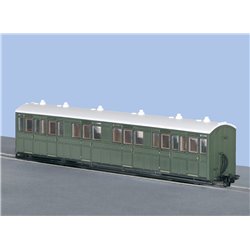
Composite Coach Green Unlettered
Price: £ 59.95Composite Coach Green Unlettered These finely detailed ready to run coaches...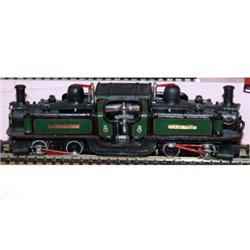
Festiniog double ended Fairlie - Unpainted
Price: £ 107.80Festiniog double ended Fairlie (OO/OO9 Scale 1/76th) Kit Includes valve gear,...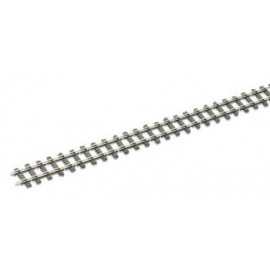
OO9 Flexible Track Wooden sleeper type - Code 80
Price: £ 7.60OO9 Flexible Track Wooden sleeper type - Code 80 Length of each track: 1 yard...
Related posts
-
 What scale is Hornby?Hornby model railways are OO Scale or 1/76th that is 4 millimetres to the foot (12 inches). It runs on a track with...
 - How to weight my model so it does not tip?For wargaming figures, a small coin or washer glued to the under side of the base will usually to do the job. This...
- Is Bachmann compatible with Hornby?Yes, any OO scale loco, wagon or coach will work on any OO scale track, regardless of brand. Couplings are also...
- What are the model railway eras?According to Bachmann, as it states in their catalogue there are 9 eras. As they say in their catalogue this is not...
- Can a "DCC ready" train be used on analogue?Yes, you can use a DCC ready train on your analogue layout. DCC ready just means that the train has been factory...