When gluing parts, it is best to hold them in place especially if it is a large area you need to join together, such...

Cart 0 Product Products (empty)
No products
Free shipping! Shipping
£ 0.00 Total
Product successfully added to your shopping cart
Quantity
Total
There are 0 items in your cart. There is 1 item in your cart.
Total products (tax incl.)
Total shipping (tax excl.) Free shipping!
Total (tax incl.)
Search Tips
Tips categories
Latest Tips
-
 How can I keep parts in place during gluing?Read more
 -
 What was the Bachmann 'Blue Riband' subbrand ?Read more
The Blue Riband subbrand was a significant step in the evolution of Bachmann Branchline, the UK division of Bachmann...
-
 What is a Weekend Edition model plane kit?Read more
'Weekend Edition' plastic model plane kits are a type of kit offered by plastic kit manufacturer Eduard alongside...
-
 What is a good age for a child's first layout?Read more
Several factors will influence the age at which your child is ready for their first layout. These include the...
-
 What is the best wood for baseboards?Read more
The most common wood for baseboards is probably chipboard as this is relatively inexpensive. Plywood is another...

Can I fit a DCC decoder on my own?
Whether or not it is realistic to consider fitting a decoder yourself depends on numerous factors. And not one of them has anything to do with actually plugging one in!
Assuming you're asking the question because you have never fitted one before, we'll start with the best-case scenario. If you have a model that is DCC ready, and you still have the manufacturer's instructions containing information on how to remove the bodyshell (or at least gain access to the DCC socket if located elsewhere), and you have identified which decoder is required for your model, and you don't mind fiddly work, then the answer is yes, it is possible to fit a decoder yourself. In fact, under these circumstances it is not only possible but easy too, so give it a go!
If any of the above conditions are not met, then the process becomes a little more involved. Taking the bodyshell off a model locomotive used to be easy, Hornby and Lima models from the '70s and '80s were probably the easiest, utilising bodyshells that simply clipped over a chassis-mounted tab. But nowadays, models often have hidden screws that unwind for days before letting go of their grip on the bodywork, and that's assuming you can find and gain access to the body screws in the first place. But if removing your bodyshell is your only problem, think of it more as a challenge that will likely cause you to use some colourful language, rather than a barrier to fitting your decoder.
If you don't know which decoder to use, your model shop or model supplier should be able to help you. They will probably be more than happy to sell you one too, so it's a win-win!
The last consideration, however, is a little bit of a deal-breaker. If your model is not DCC ready, a decoder will have to be either hardwired in, or an appropriate socket will need to be fitted. This is the point at which the advice turns from give it a go, to give it a go if you know what you're doing. And with the absolute greatest of respect for anybody willing to give it a go, if you have asked the original question 'Can I fit a DCC decoder on my own?' you will probably need a little help with this one. But that is what we are here for, model shops, modelling clubs, and even modelling neighbours, they all want to help. In fact, try stopping them!
Posted in: Power and control
Click here to receive the tips weekly in your mailbox. You can unsubscribe at any time.
Related products
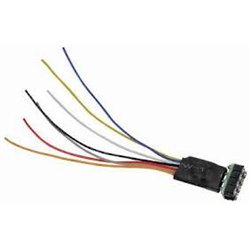
6 Pin Decoder Socket with 8 Pin Plug x 3-Duplicate
Price: £ 18.956 Pin Decoder Socket with 8 Pin Plug x 3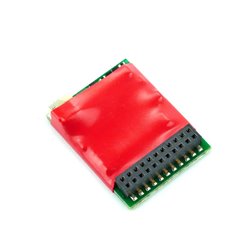
Ruby Series 6fn Pro DCC Decoder 21 Pin
Price: £ 39.50Ruby Series 6 functions Pro DCC Decoder 21 pin The DCC95 is a direct plug 21...
Related posts
-
 Can a "DCC ready" train be used on analogue?Yes, you can use a DCC ready train on your analogue layout. DCC ready just means that the train has been factory...
 - Is it difficult to fit a DCC decoder in to a DCC ready engine?In theory, it should be easy as the whole idea of being DCC Ready is to simplify the process. The first time I did...
- What is 7/0.2 wire?7/02 wire is a wire made of 7 strands of 0.2mm wire. Stranded wire has the advantage of being flexible while solid...
- Is an N Gauge controller compatible with OO Gauge?Yes, an N Gauge controller is compatible with OO gauge trains. You may have to change the power clip to the track...
- Is stranded wire better than solid wire?In my experience, stranded wire is preferable over solid wire. Stranded wire is more flexible than solid core wire,...